Flashcards
Ask Bloom to make flashcards from your lecture notes. Answer from memory, flip each card to check, and save the deck for later.
Sound waves
1 of 3

Personalised, course-grounded support for every student. Design AI-guided learning experiences, assess understanding and gain deeper insights into learning, with educators in control.
97% satisfaction rate, used by tens of thousands of students

| Your partner | You stay silent | You confess |
|---|---|---|
| Stays silent | 1 year | Go free |
| Confesses | 5 years | 3 years |
Use both volumes to explain which way water moved.
Question 1 of 1 · 1 pt
Fri · 64 messages
Fri · 19 active users













Bloom has reached tens of thousands of students. These results come from individual courses.
Bloom’s internal observational results. Satisfaction is based on survey responses, retention on one online cohort, and email volume on one lecturer’s report. Prior achievement and engagement may also explain differences between groups.
Bloom draws on approved course materials and can cite pages and slides, helping students check information and stay aligned with your curriculum.
Course materials
Drop files here
PDF, DOCX, PPTX...
Your knowledge base
With cited answers
The exam covers chapters 3–5. Office hours are Tuesdays 2–4pm...
Can you just give me the answer to ? I only need the number.
I can give you a hint and check your answer. Which function has as its derivative?
Tangent. I tried and got . Is that right?
Almost. Differentiate to check your work. What extra factor does the chain rule give you?
A factor of ! So I need . At the two limits I get .
Yes. Your factor of one half cancels the two from the chain rule, and you used both limits correctly.
You choose when Bloom gives a worked example and when students practise independently. Here, the teacher’s pedagogical guardrails allow hints and feedback on a student’s attempt. Bloom checks prior knowledge and leaves the final calculation to the student.
Research shows generic AI tools can actually harm learning outcomes. A University of Pennsylvania study found students using generic AI performed 17% worse on unassisted exams, because it gave answers instead of building understanding. Read our analysis.
Activities & Programs
Build formative assessment into your activities. Bloom asks students to explain their thinking and gives feedback as they work. Link activities and lessons in the order you choose, and Bloom delivers the complete program step by step.
Use both volumes to explain which way water moved.
Assessment & Feedback
Students can talk to Bloom during a quiz, ask for a hint and explain why they chose an answer. An explanation can reveal a misconception even when a student picks the right option.
Question 1 of 1 · 1 pt
Learning Intelligence
Start with your lecture slides, readings and lab guides. Bloom suggests the skills students need and maps how those skills build on one another.
Explain osmosis
Use concentration differences and membrane permeability to explain the net movement of water.
Prerequisites · Compare concentrations, Describe membrane permeability
Source · Osmosis in red blood cells · lab guide
Explore a lesson on sound waves with Bloom beside you. Write up your observations in Canvas, test a prediction in Code, or open the lecture notes and video in Resources.
Observation. The second sound had a higher pitch.
| Frequency | Period |
|---|---|
| 220 Hz | 4.55 ms |
| 440 Hz | 2.27 ms |
When the frequency doubles, each cycle takes half as long.
Why did the pitch rise?
Physics 101 · Lecture notes
A sound wave repeats a pattern of high and low pressure. Its frequency tells us how many cycles pass a point each second.
Ask Bloom to make flashcards from your lecture notes. Answer from memory, flip each card to check, and save the deck for later.
Use our mathematics editor, write chemical equations, graph functions, and write code.
Institutional Infrastructure
Bloom is an intelligent learning layer alongside your existing LMS and institutional systems, not a replacement for them.
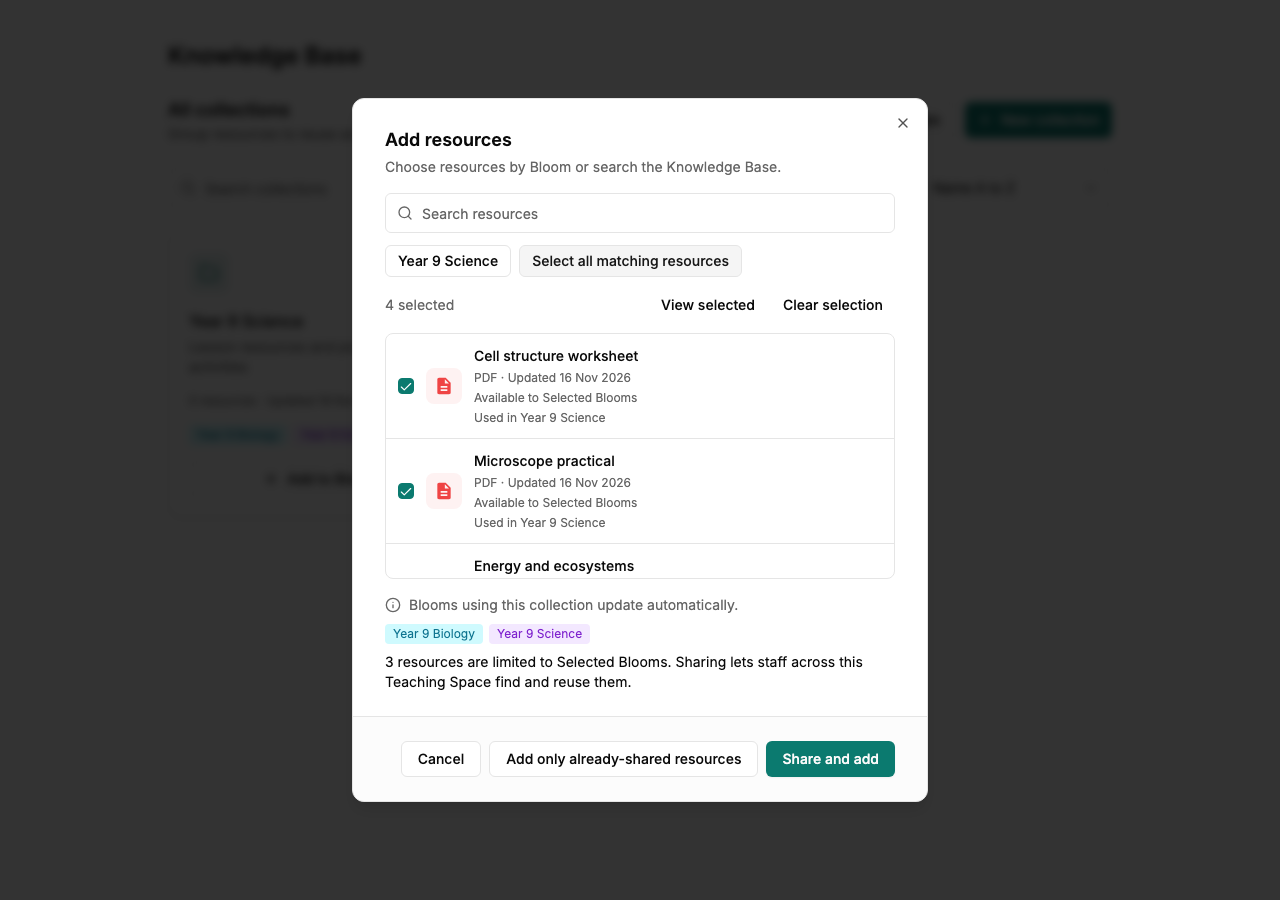
Manage approved resources centrally, organise them into collections and reuse them across individual Blooms. Updates flow through to linked Blooms with their own visibility controls.
Set shared values, context and teaching guidance at the Teaching Space level while educators retain course-specific control.
Use LTI 1.3 Deep Linking to add a Bloom or an individual shared activity to compatible LMS courses. Wonde integration supports school enrolment workflows.
Import calendar files or subscribe to supported iCalendar feeds to share term dates, exams and institutional events.
Availability and integration configuration depend on your plan and institution.
Bloom doesn't just answer questions, it guides students through understanding, using evidence-based pedagogical techniques.
In partnership with UNSW Sydney, we've secured a $480,000 Ignite grant from Australia's Economic Accelerator to develop AI that genuinely helps students learn.


Academic advisor
Pioneer of Cognitive Load Theory, which informs how guidance can be matched to learners’ prior knowledge and task complexity.

Academic advisor
Pioneer of intelligent tutoring systems and research into effective tutoring and adaptive instruction.
Classroom case study
Explore findings from a small Year 12 Psychology case study at St Hilda's School, including confidence and study habits.
Read the case study


"Bloom allows me to ask questions in a safe space."
Second Year University Economics Student
"Bloom is super helpful when I want to get my question answered when no one is there to help."
Year 11 Economics Student
"It provides easy to understand answers, and it also provides great questions to get us thinking."
Year 12 Psychology Student
"I would say above all else the best part of this course was Bloom."
Third Year University Data Science Student
“Students are receiving relevant feedback in real time, freeing teachers to focus on what matters most.”

Michael Rodenburg
Head of English, Scotch College Adelaide
“Bloom AI truly get education, understanding both student needs and teacher demands. A team deeply committed to meaningful educational outcomes.”

Joanne Villis
Head of Technology Enrichment, St Dominic's Priory College
“What convinced us it was working were the usage insights and, more importantly, seeing students engage with it in a genuinely Socratic way: asking better questions and showing stronger critical thinking.”

Bella Pickett
Head of Psychology, St Clare's Oxford
“It guides students toward understanding instead of just telling them the answer. An excellent service I intend to keep using.”

Prof. Florian Breuer
Professor in Pure Mathematics, University of Newcastle
Beyond the classroom
A conversation at ASU+GSV
“There is no doom
and gloom
with Bloom.”
will.i.am
In conversation with Bloom founder Gary Liang
San Diego, California, USA
 ASU+GSV 2026
Recognition & conversations

Sydney, Australia
2026 Research & Education finalist for AI that guides student learning and critical thinking.
Read the announcement
Sydney, Australia
At EDUtech Australia, sharing how Khan Academy inspired Bloom and the importance of working with educators.
We take security seriously. From encryption to compliance, Bloom is built with the security infrastructure that institutions demand.
Data from paid institutional accounts is never used for model training. De-identified data from free accounts may be used to improve Bloom by default, and users can opt out at any time.
Institutions retain full ownership over their course materials and student data. No other institution can access your proprietary content.
We support access requests, deletion requests, and data portability where applicable.
Run on any large language model, including open-source options hosted on your own infrastructure for full control.
Data encrypted at rest using AES-256 and in transit using TLS, following industry best practices.
Integrate with your organisation's Single Sign On and add multi-factor authentication for extra protection.
Everything you need to know about Bloom. Can't find what you're looking for? Contact our team.