The constraint is not technology. It's institutional adoption.
This essay won the Grand Prize at the EdTechnical AI in Education Forecasting Competition. Track 3 asked the question: By the end of 2028, what percentage of high school students will spend more than 2 hours per day in school learning through AI-powered, personalized and/ or gamified educational content that adapts to their individual interests and learning pace?
This forecast was developed under tight time and length constraints. Given more time, we would be able to improve the model in a number of ways, including developing a diffusion model, segmenting the forecast by school type, including constraints beyond just policy, and adding sensitivity analysis.
The core message would remain the same: technological capability will outpace institutional adoption. The platforms that cross the 2-hour daily threshold will not be those with the most capable models, but those that able to bypass institutional and political barriers to deeply integrate into educator workflows, curriculum, assessment, and school structures.
Check out the announcement LinkedIn post here, where you can find the other prediction essays.
By the end of 2028, we forecast that 2.2% of US high school students will spend more than 2 hours per day in school learning through AI-powered, personalized and/or gamified educational content.
AI-powered platforms are already capable enough to deliver a personalized learning experience. Early deployments already show learning gains.[1] We put a 76% probability that AI tutoring systems match the best human tutors by 2028 (0.95 × 0.8). The constraint is not technology; it's institutional adoption. The bar of more than 2 hours per day, in school, is extremely high. This effectively means that schools have reallocated 25–30% of the day to adaptive systems. Schools must overcome political (e.g., state approvals) and institutional barriers (e.g., teacher adoption) in order for this to occur.
The closest we have in the US to a system like this is Alpha School, using the 2 Hour Learning method. As of time of writing, they have around 20 campuses across the US, having started in 2016.[2] Our view is that these platforms will not be mainstream in public schools, and only in charters, privates, microschools, and alternative models.
Our forecast rests on a structured probability decomposition, informed by interviews with Kurt VanLehn (leading ITS expert, Arizona State University), a labor economist from UPenn, and an education policy expert.
Intelligent Tutoring Systems vs. AI
We have had systems near-human efficacy in controlled settings for decades, in the form of Intelligent Tutoring Systems (ITS). These were already "personalized" and "AI-powered". They were also typically gamified: progression systems, immediate rewards, and social comparison mechanics designed to sustain time-on-task and mask the cognitive work underneath.[3] Many of them suggest around 30 minutes a week of use, which is far below the 2-hour-a-day bar.
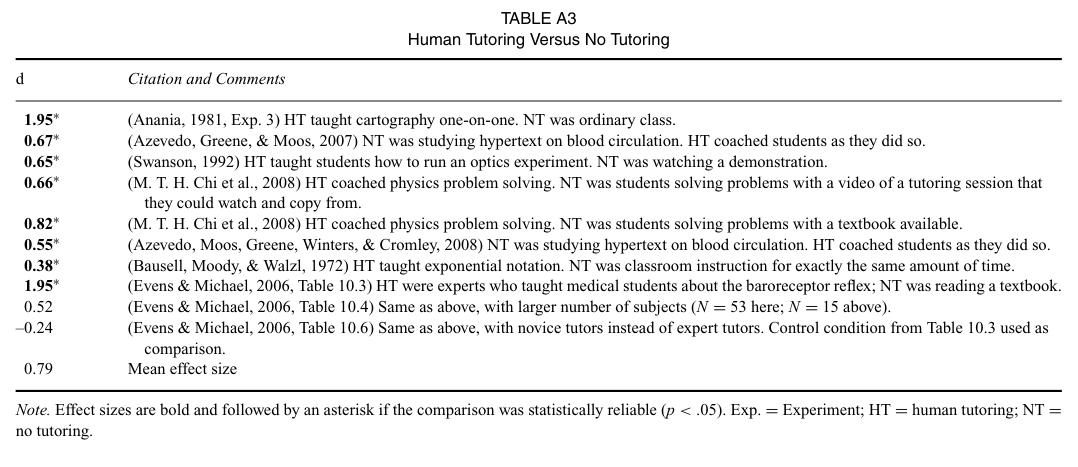
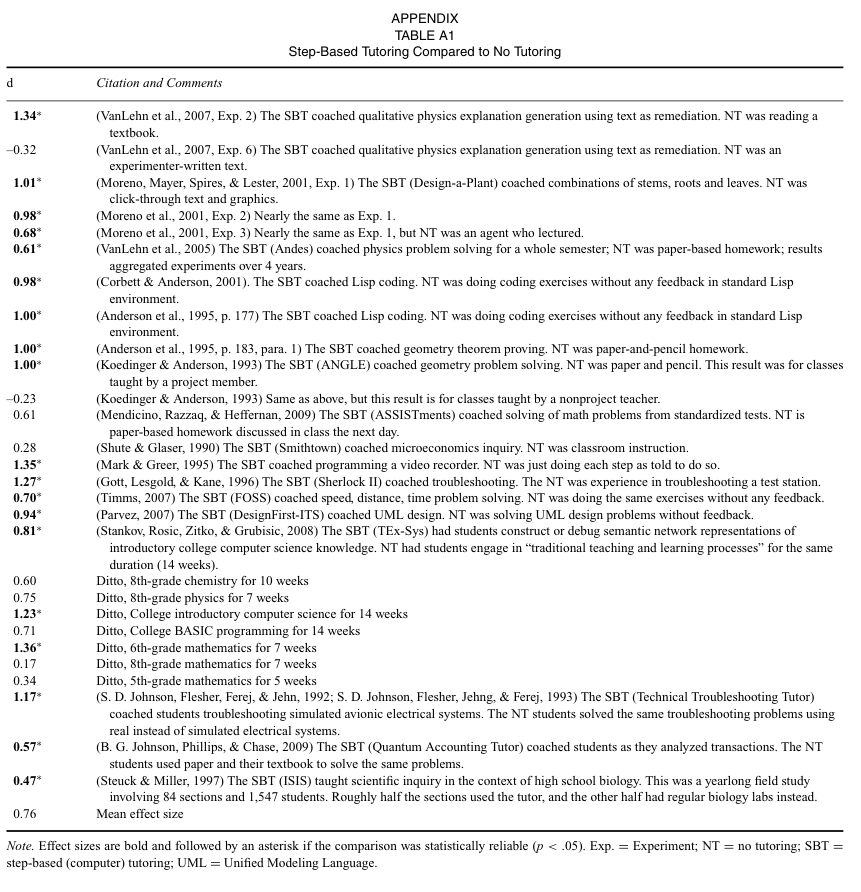
Just because technology achieves learning gains, doesn't mean it will lead to student adoption. Many look to Bloom's two-sigma result: one-to-one tutoring with mastery learning produced achievement gains 2 standard deviations (σ) above conventional classroom instruction.[4] However, VanLehn brought this expectation back to earth, showing that human tutoring typically yields a 0.79σ improvement over no tutoring (see Appendix).[5] The same study showed that ITS yields an average of 0.76σ, almost as effective. Yet, their learning gains have not flowed into the real-world.[6]
The current paradigm of AI is likely superior to ITS. One technological difference between AI and ITS is that ITS operate on fixed curricula and do not have the flexibility to adapt to individual changes. A lesson was a lesson, same sequence, same pace, same checkpoint assessments for every student, regardless of prior knowledge or learning speed. But that improvement doesn't solve the core problem in our forecast: getting to more than 2 hours per day requires fundamental changes in the schooling system.
Our forecast
Our forecast identifies the percentage of students that will utilize these personalized AI-platforms for more than 2 hours per day. We structure the forecast as follows:
% of students using AI platform for more than 2 hours a day
= Pr(Model Capability)
× Pr(System Design | Model Capability)
× % of states which would accommodate AI shift by 2028
× Average % of schools per state which shift their schedules to accommodate for more than 2h/day usage by 2028
= 0.95 × 0.8 × 30% × 10% ≈ 2.2%
M – Model Capability (0.95) — by 2028, frontier models are good enough to support learning growth equivalent to high-quality human tutors. We justify our estimate as follows. Firstly, the underlying LLMs are already at superhuman problem-solving levels in mathematics, sciences, software engineering, and knowledge work tasks.[7]
Figure 1: Test scores of AI systems on various capabilities relative to human performance
Second, LLMs exhibit strong levels of pedagogical knowledge, with Gemini 3 Pro scoring 91% on the pedagogy benchmark.[8] Thirdly, LLMs have already been fine-tuned to exhibit pedagogical behavior, namely LearnLM from DeepMind.[9] We discount slightly from 100% to account for the difficulty for models to break free from their pre-training, which optimizes to provide immediate answers. We note that the capability frontier is jagged and this probability may differ by year level or subject area.[10]
S – System Design (0.8 | M) — by 2028, given capable models exist, someone turns them into a coherent tutor system which is gamified and personalized which schools would use. Raw model intelligence is not enough, the marginal returns diminish.[11] LLMs excel at the inner loop — responding well to the current question — but scaling tutoring requires an "outer loop" that maintains memory, measures mastery, and decides what the student should do next over time.[12] In our own experience deploying AI tutors across schools and universities, most of the hard work has been in product and pedagogy. The problem is difficult but tractable. We discount from 100% to 0.8, because few organizations have the right mix of learning science, engineering, and institutional access. Many will settle for homework-help chatbots.
Policy Barriers (30%) — by 2028, the fraction of states that would allow a school to reallocate ~25–30% of instructional time to AI-mediated learning without violating seat-time, accreditation, or assessment rules. By 2025, 31 states had issued K–12 AI guidance, which indicates the system is shifting.[13] Despite this, the regime is still fragmented. Schools operate under inconsistent rules, ranging from outright bans to permissive use without clear policies, making it hard to standardize district-wide instructional models.[14] That uncertainty also slows procurement, curriculum integration, and measurement, because districts cannot confidently define "approved use" at classroom scale.
School-Level Adoption (10%) — by 2028, the average proportion of schools in allowed states who go through with a schedule change. Regulatory permission is necessary but far from sufficient. Even in states where schools are allowed to redesign schedules, only a minority will actually do so. Reallocating 25–30% of the school day to adaptive AI systems requires a fundamental rewrite of timetables, staffing models, and instructional norms.[15] Historical precedents are instructive: block scheduling, mastery-based grading, and large-scale ITS deployments have diffused slowly even when permitted and supported. VanLehn himself told us that the key bottleneck to ITS was "integration with classroom processes".
Implications
AI adoption will be uneven, not systemic. Because more than 2 hours per day requires a timetable rewrite, AI-mediated learning will concentrate in charters, privates, and alternative models rather than diffuse across to the median public school.
Institutional integration matters more than model quality. Learning gains at scale will depend less on AI capability, and more on how tightly systems are integrated into schedules, assessment, incentives, and teacher workflows.
Appendix A: Human Tutoring vs. No Tutoring
Appendix B: Intelligent Tutoring Systems vs. No Tutoring


About the author

Gary Liang
Founder & CEO
Gary founded Bloom AI in 2023 to harness AI to improve learning outcomes. He has been an educator for 15 years, across high school and university, including teaching at UNSW and the University of Sydney. He is a former strategy consultant at McKinsey & Company.
LinkedIn